AI Code Verification vs AI Code Review: What’s the Difference

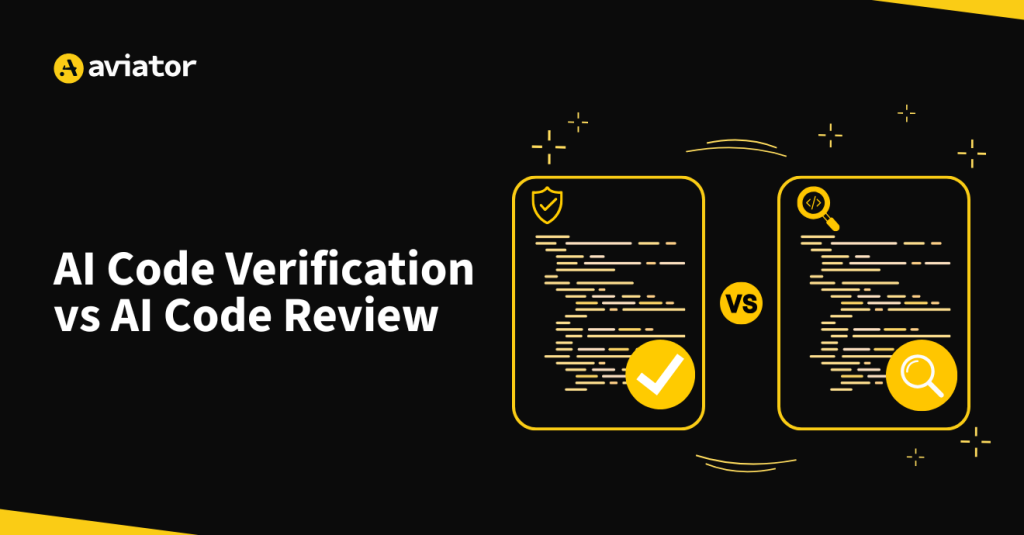
Two engineers recently described what sounded like the same tool to me. One called it “our AI code review.” The other called it “our AI verification step”. Were they talking about different things? Neither was completely sure, but that’s not uncommon, since this mix-up is everywhere right now. However, the two terms shouldn’t be used interchangeably, because these two operations actually answer completely different questions.
AI code review reads your diff and comments on it. It looks at the changes and tells you what might be wrong. AI code verification checks if the implementation matches what the engineers intended to build. You probably want both, as they solve completely different problems.
TL;DR AI code review samples the diff and produces helpful, but non-deterministic and intent-blind comments. AI code verification checks code against a human-approved spec and produces pass-or-fail evidence per set of criteria, with an audit trail.
What AI Code Review Does
AI code review is the one you’re probably already familiar with. A tool (CodeRabbit, Greptile, GitHub Copilot’s reviewer, and friends) reads the PR diff, infers what the change is about from the names and the context, and then posts comments related to:
- Potential bugs
- Style bits and bobs
- Missing test coverage
- Security shenanigans
A human, or another agent, reads those comments and decides what to do next.
I don’t want to downplay AI code review, it’s genuinely useful. It’s fast, scales across a lot of PRs, and is good at catching the things that you’d need a fresh set of (statistical) eyes to spot: obvious mistakes, inconsistent styles, forgotten null, and the like. As a first-pass filter on volume, it’s pretty good.

But that’s where it hits the ceiling. A reviewer, human-based or AI-based, is sampling the code without knowing what the change was supposed to accomplish. It can infer intent from the diff, but inference is not the same as an authoritative source of truth. If a function is technically fine but does the wrong thing, the reviewer has no external reference to compare it against.
“The AI reviewed it and had no comments” is not the same as, “The code works as intended”. Just because there are no complaints, there’s no guarantee everything is correct.
What AI Code Verification Does
Verification starts much earlier than the review. Before any code is written, the intent is captured as a spec scope alongside a list of acceptance criteria. A human™ approves the spec. Then the work begins (whether it’s done by you, an agent, or someone/something else), and verification checks the implementation against each criterion.
Aviator Verify, for example, routes each criterion to the method best suited to answer it. Structural matters (“Does this endpoint exist?”; “Were new dependencies added?”) go to a code-scan of the abstract syntax tree (AST). Behavioral criteria are exercised against a running build. Recurring team rules are matched as reusable invariants. And if there’s anything that none of those methods can cover, it falls back to a labeled model check. Every verdict is accompanied by supporting evidence.
The catch (and the trade-off) is that verification only works if the agreement exists as an explicit artifact. No spec + no reference point = no verification.
Differentiators
So, let’s see what actually separates the two side by side.
| AI code review | AI code verification | |
|---|---|---|
| Input | The diff | The approved spec + the code |
| Question asked | “Does this look right?” | “Does this match what was approved?” |
| Knows intent | No (guesses from the code) | Yes (captured before the PR) |
| Output | Comments and suggestions | Pass/fail evidence per criterion |
| Determinism | Varies between runs | Same result every run (with a labeled model fallback) |
| Audit trail | A thread of comments | Immutable record per criterion |
| Where the human sits | Reads the diff after | Approves intent before |
The row that surprises people the most is the last one, where the human sits. Namely, AI code review keeps the checkpoint at the end, on the diff, whereas with verification, it comes before any code exists.
And note the middle row, determinism, because it is the one with teeth. Which brings us to our next section.
Determinism Matters
Run an AI reviewer over the same pull request twice, and you’ll likely get two different sets of comments. Now, you may be compelled to think of this as a bug, but it’s not. It’s just how sampling from a probabilistic model works. This sort of variability is fine, even useful, when you want to catch potential issues. However, when you want to prove something, it becomes a problem.
A deterministic check returns the same verdict for the same input on every run. The evidence remains the same, as well. This property may sound unnecessarily academic until you need to demonstrate something to someone who wasn’t there. And be honest, “The AI looked and didn’t complain” doesn’t cut it. On the other hand, “This criterion was checked, here is the repeatable result, here is who approved the spec and when” does.
⚠️

A fair caveat: Verification is not magic determinism all the way down. Some criteria resist static or execution checks, so they fall back to model judgment. These verdicts should be labeled clearly as such (for instance, Aviator marks these with a confidence threshold). Honest verification tells you which verdicts are deterministic and which are judgment calls. Anything claiming 100% determinism on arbitrary code is overselling.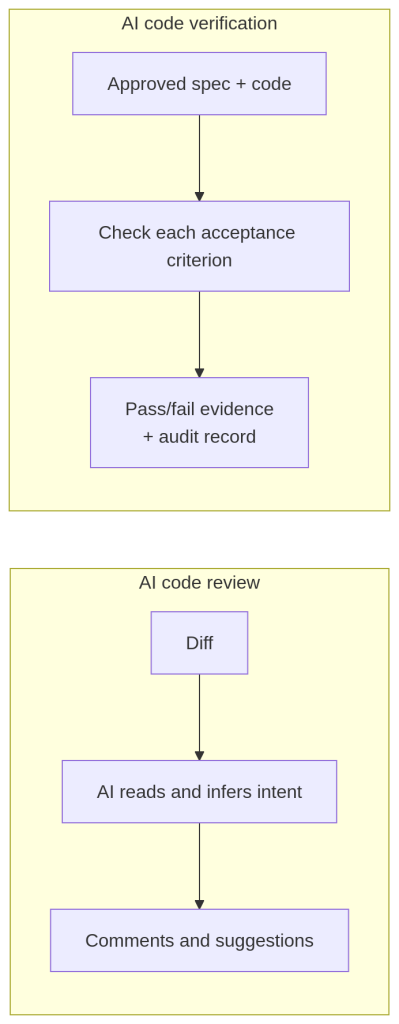
The shortest way to see the difference: review flows from the diff, verification flows from the approved spec
Do You Need Both?
Short answer: yes, and they cannot serve as substitutes for each other.
These are two separate jobs basically. Review handles breadth and signal. It reads everything cheaply and flags the likely problems across a high volume of changes. Verification confirms intent match. It proves, criterion by criterion, that the specific thing you agreed to build is the thing that got built.
Neither covers the other’s blind spot. For example, a reviewer won’t tell you a requirement was missed if the remaining code looks clean, just like a verifier won’t call out a variable name that’s technically fine but confusing.
Verify Code, Now
Though the two terms are often used interchangeably, the operations themselves do not refer to the same thing. Review reads the diff and gives you comments. It’s fast and broad, but it’s also blind to intent. Verification, on the other hand, checks the implementation against an approved spec and gives you repeatable, evidence-backed pass/fail results + an audit trail.
If you’re tired of the “an AI reviewed it, ship it” mindset, then verification is that missing piece you’re looking for. And the best part is, it doesn’t replace your review tools. It works alongside them.
Aviator Verify ties all these pieces together. You keep your agent and your reviewer, capture intent through the Aviator MCP (Model Context Protocol), and let each acceptance criterion be checked with evidence before merge. Request access to Verify now.
Frequently Asked Questions (FAQ)
Is AI code verification the same as AI code review?
No. Review reads the diff and posts comments, inferring intent from the code. Its output varies between runs. Verification checks the implementation against acceptance criteria that have been approved beforehand, and the results are the same each time.
Can AI code verification replace my AI code reviewer?
No. Still, even though these two cover different blind spots, they can complement each other.
Why does determinism matter for verifying AI-generated code?
Because you often need to prove something is correct, not just get a second opinion. A deterministic check returns the same verdict and evidence every run, which is what auditors and compliance frameworks like SOC 2 or ISO 27001 require. Non-deterministic review comments cannot serve as that kind of proof.
How is verification different from just running tests?
Tests check code against the behavior the author has expected, so an agent that has misread the requirement can write both the wrong code and passing tests for it. Verification checks against an independent, human-approved spec. This gives it an outside reference point that same-source tests lack.